
DENKblatt
03/2025New: DENKtester for hardware tests
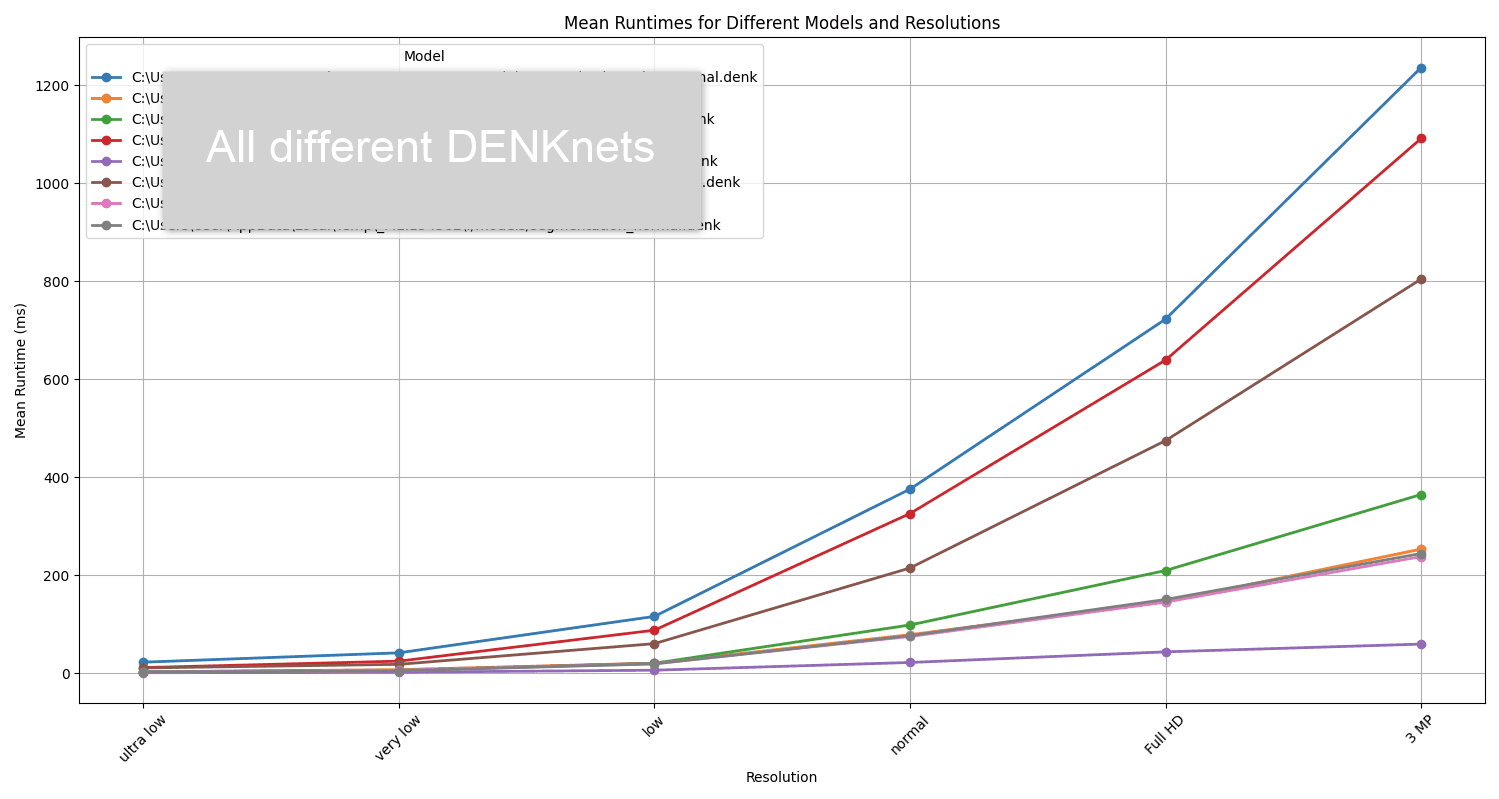
How fast are the images processed on my hardware?
Customers can now use the DENKtester to check the inference times of DENKnets: The variables image resolutions and complexity of the networks are included and tested with different parameters.
Is your hardware fast enough? Find out with the DENKtester! ⏱️
Are you using or planning to use our DENKnets? Then it is crucial to know whether your hardware achieves the desired evaluation speed - or whether an upgrade is necessary. This is exactly why we have developed the DENKtester!
Find out with the DENKtester:
✅ How quickly your hardware analyses our various networks
✅ Which image resolutions & networks affect your system performance
✅ Whether your current components are sufficient - or whether a new graphics card would make sense, for example.
At the end, you will receive clear comparison graphics of all tested models, image resolutions and runtimes - to help you make an informed decision. 📊
🔍 Test now whether your hardware meets the requirements.
Please send enquiries to support@denkweit.de.
New in the hub: orientated bounding boxes
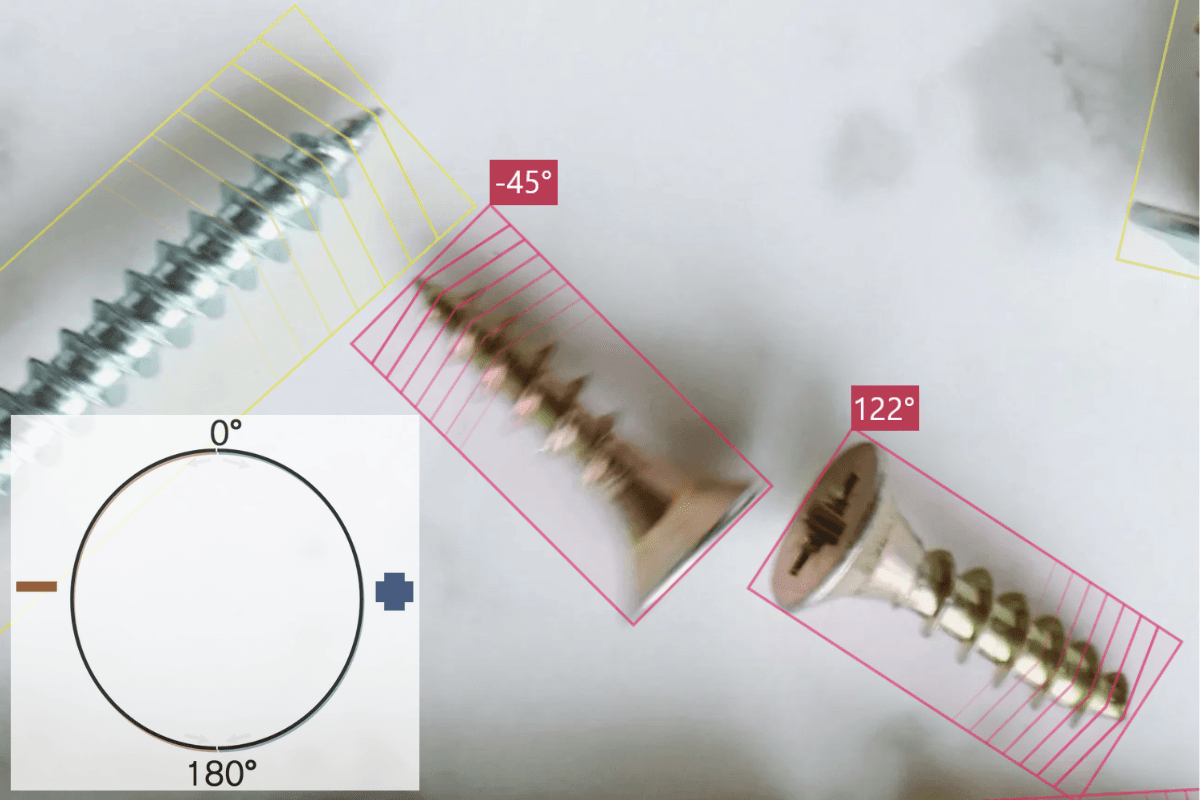
2nd development stage of the ‘rotated bounding boxes’. Users now also receive a statement about the orientation/alignment of their objects with angles.
Who is it relevant for?
Primarily for pick and place applications where precise rotation information is important for gripping.
Measurements are taken from 0° - 180°.
0°: The object is orientated exactly upwards (12 o'clock).
Positive angle: The object is rotated clockwise.
Negative angle: The object is rotated anti-clockwise.
Everything that is aligned to the right of the full circle has a positive sign. All objects with the tip to the left of the full circle have a negative sign.
Use orientated bounding boxes:
Set two tick marks in the DENK VISION AI Hub when creating an object detection:
Additional Object Detection Options:
✅ Rotatable bounding boxes
✅ Orientation Matters
If you have any questions, you can contact our customer support at support@denkweit.de
Use case: Pore detection, Schüller Möbelwerk

Process optimisation at Schüller Küchen with AI-supported pore detection
Schüller, a traditional company with over 60 years of experience, produces 700 to 800 kitchens for the global market every day. In order to further increase quality and efficiency, the identification of components has been optimised with AI-supported pore recognition.
Automated component allocation with DENKnet
Previously, components were identified by manual measurement - a time-consuming process. The new AI-based solution enables precise, automated recognition based on colour-independent criteria such as grain and pore structure. Previous attempts with classic algorithms achieved error rates of up to 7%, while DENKnet achieved an accuracy of 99.9%.
Challenge: recognising deep black surfaces
In order to reliably distinguish between all colours and fronts, the AI was trained with just 720 images and has already been successfully integrated into production. By using the ‘Classification’ technology, Schüller was able to reduce the error rate to less than 0.1%.
Seamless integration into existing systems
DENK Vision AI was implemented without any structural changes. Only an additional graphics card was installed to allow the AI to be analysed in real time.
Results: Maximum efficiency and minimum error rate
Before: External AI with 1% error rate - 150 incorrect assignments for 12,000 components in 3 days. With DENKnet: Error rate of just 0.1% - only 13 incorrect allocations in 3 days.
Due to independent follow-up training by Schüller, the error rate could be reduced even further! A clear gain for efficiency and quality.